
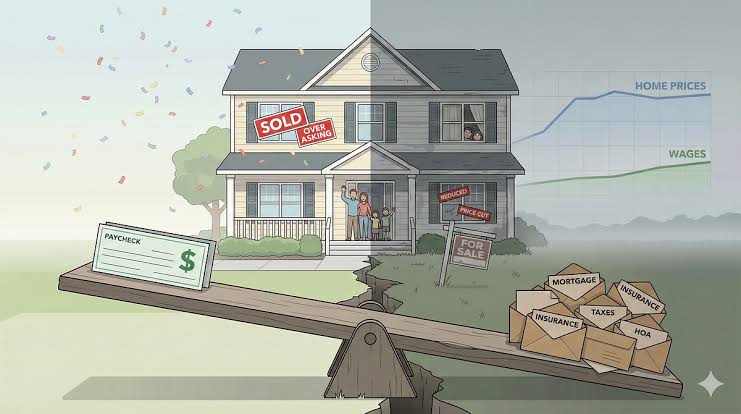
If you’ve been waiting for the American housing market to either come crashing down or come roaring back to pandemic-era frenzy, 2026 has a message for you: neither is coming. Instead, the market has settled into something economists are increasingly calling the “Great Housing Reset” — a slow, grinding, unglamorous return toward something that resembles normal, after years of whiplash.
Prices Keep Climbing, Just Slower
The national median existing-home price reached $429,300 in May 2026, a level that would have seemed unthinkable just a few years ago. Yet the pace of growth has cooled dramatically. Home prices rose just 1.3% year-over-year as of that same month — the 35th consecutive month of gains, but a far cry from the eye-popping increases of over 15% seen at the pandemic’s peak. Since the beginning of 2022, home values have appreciated by roughly 17% overall, according to the S&P Cotality Case-Shiller Home Price Index, even as mortgage rates simultaneously spiked.
Forecasts for the rest of 2026 vary but land in a similarly modest range. Fannie Mae projects prices will rise 3.2% this year, the National Association of Realtors expects around 4%, while Zillow’s more conservative estimate puts growth at just 1.2%. Nobody in the mainstream forecasting community is predicting a crash — but nobody’s predicting a return to bidding-war mania either.
The Rate Story: Stuck, Not Falling
Mortgage rates remain the single biggest force shaping buyer behavior, and in 2026 they’ve largely refused to cooperate with hopeful buyers. The 30-year fixed rate has bounced around in a range roughly between 6% and 6.65% for much of the year, occasionally dipping below 6% but never staying there for long. Most major forecasters — Fannie Mae, the Mortgage Bankers Association, and the National Association of Realtors among them — expect rates to remain in the 6% to 6.5% range through the rest of the year, a level that’s a meaningful improvement from the 7%-plus highs of 2023, but nowhere close to the ultralow rates of the pandemic era that many buyers are still mentally anchored to.
That mismatch between expectation and reality has created a strange kind of standoff. In a May 2026 survey, nearly two-thirds of prospective homebuyers said they were waiting for mortgage rates to fall before making a purchase — but that exact same share of people said the same thing in 2025, and rates never obliged. Housing economists note a real cost to this hesitation: while would-be buyers wait on the sidelines for relief, home prices have simply kept climbing, meaning the “wait and see” strategy has often left people worse off than if they’d bought earlier.
Inventory Is Loosening, But Slowly
One of the more encouraging threads in the 2026 housing story is inventory. Housing supply remains below the healthy benchmark of 5 to 6 months that typically characterizes a balanced market — sitting closer to 4.5 months in many analyses — but it is gradually increasing after years of severe shortage. Existing home sales have shown modest signs of life too, ticking up 3.2% in one recent month to a seasonally adjusted annual rate of 4.17 million units, and Zillow projects a total of 4.26 million existing home sales for the full year, a 4.3% increase over 2025.
Encouragingly, the number of major metro markets seeing outright price declines is expected to shrink significantly. Home values fell in 24 of the 50 largest U.S. markets as of late 2025; Zillow forecasts that number will be roughly cut in half, to around 12 markets, by the end of 2026 — a sign that the sharpest regional corrections may be behind us.
A Tale of Two Regions
Averages hide a lot in the 2026 housing market, and the regional divergence has become one of the year’s defining storylines. The Northeast and Midwest have generally continued appreciating, while markets in the West have softened noticeably. States like Illinois, Kansas, and Wisconsin have posted some of the strongest price gains in the country, while previously red-hot Sun Belt and West Coast markets have cooled considerably as inventory catches up with demand in those regions. For buyers, this means the national headlines matter far less than what’s happening in their specific metro area — a Midwest buyer and a West Coast buyer are effectively navigating two entirely different markets right now.
What’s Actually Changing Buyer Behavior
Faced with high prices and stubborn rates, buyers are getting creative. Surveys show growing numbers of Americans turning to side hustles specifically to fund a home purchase, or teaming up with friends to buy property jointly — approaches that would have seemed unusual a decade ago but are becoming a normalized part of the affordability conversation. Adjustable-rate mortgages, which offer lower initial rates in exchange for future rate uncertainty, are also seeing renewed interest from buyers willing to bet that rates will ease further down the road. Homebuilders, meanwhile, have leaned into incentives — rate buydowns, closing cost credits, and design upgrades — to keep new construction moving in a market where resale sellers are often reluctant to budge on price.
The Bottom Line for 2026
Perhaps the most important number in the entire housing conversation is this one: according to the National Association of Realtors, even a single percentage-point drop in mortgage rates would expand the pool of qualified buyers by roughly 5.5 million households. That statistic captures just how much pent-up demand is sitting on the sidelines, waiting for even modest relief. Until that relief arrives, though, the market looks set to keep doing exactly what it’s done for most of 2026: grinding forward, unevenly, without the drama of a crash or the exuberance of a boom — just a slow, uneven march back toward whatever “normal” looks like next.